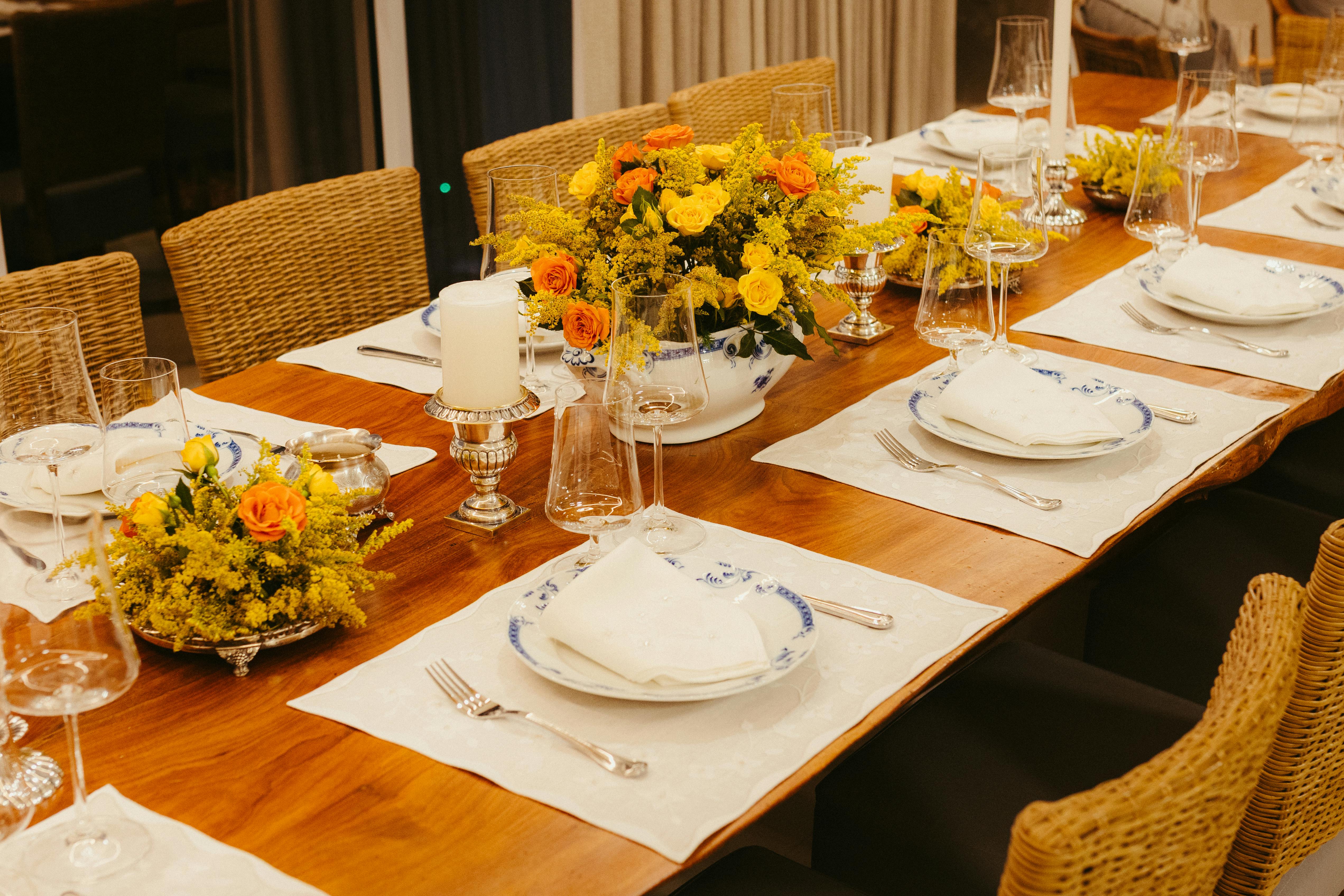
The performed dinner party is what most modern Indian homes have learned to host. The crystal is taken out. The good plates are used. The matching napkins are pressed. The menu is more elaborate than the household's usual cooking, often by a factor of two. The host is in the kitchen for most of the evening, returning to the dining table to deliver the next course and apologise for the previous one. The guests, who are friends, behave like guests at a small restaurant where the chef is also their friend. Everyone is a little stiff. The conversation is less than what it could be. The host, by ten thirty, is exhausted.
This is not what hosting was, in older Indian generations. The grandmother in Bombay or Madras who fed eight people a Sunday lunch was not performing. She was, in some real sense, just having lunch with more people than usual. The food was the food the household ate anyway, made in larger quantity. The plates were the household's plates. The grandmother sat down with everyone else. The lunch lasted three hours and the grandmother enjoyed it as much as the guests did.
What changed, between then and now, is that hosting became a performance. The household, having moved into a more individualistic and image-conscious era, began to treat each instance of hosting as an event in which the household's competence was being measured. The food had to impress. The home had to be styled. The host had to deliver. The guests, no longer just guests, became, implicitly, the audience.
What is lost in the performance
Several things are lost when hosting becomes performance.
The first is the host's presence. The host who is performing is not present. They are in the kitchen, plating, garnishing, anxiously checking the next course. They are at the table for thirty minutes of the four-hour evening, and even those thirty minutes are spent watching the guests' faces for reactions. The conversation that the host could have had with the friends they invited is, in some real sense, the conversation that did not happen.
The second is the guests' ease. Guests in a performed evening can sense the performance. They behave accordingly. They compliment the food more elaborately than they would have. They use their better manners. They check their watches. They are guests in the formal sense, which is not the relationship that produces the kind of evenings that friendships need. Friendships need ease. Performance does not produce ease.
The third is the home itself. The home that has been styled for the performance is not the home the household lives in. It has been temporarily converted into a venue. The cushions have been arranged. The candles have been lit. The fresh flowers have arrived from the florist. The home, which had its own voice, has been silenced for the evening, in favour of an idealised version that the household believes the guests want to see.
The unperformed evening is, in the end, the more confident form of hospitality. It says: this is our home, this is our food, this is who we are. Come in. The performed evening, by contrast, is anxious. It says: please be impressed.
What hosting without performance looks like
A few features of the unperformed evening, observed in households that still know how to do it.
The food is what the household eats. Maybe slightly more of it. Maybe one extra dish. But not a different cuisine, not a different scale, not a different aesthetic. If the household eats biryani on Sunday, the dinner is biryani. If the household eats simple dal-chawal-sabzi, the dinner is simple dal-chawal-sabzi, with perhaps a small extra dish. The host has confidence that the household's actual food is good enough to feed the friends. This confidence is well-placed, almost always.
The plates are the household's usual plates. Maybe the slightly nicer ones. Not the wedding crystal that gets used twice a year. Not the special occasion crockery that needs to be retrieved from the high shelf. The plates are clean, attractive, and used.
The host sits down. From the moment the food is on the table, the host is at the table. They eat with the guests. They participate in the conversation. If something needs to come from the kitchen, it comes when the natural pause in the conversation allows it, not on a schedule.
The home is the home. Not styled. Not freshly arranged. The cushions where they were yesterday. The books on the side table. The slightly worn corner of the rug. The home that has been allowed to be itself is more welcoming than the home that has been polished for the evening.
The conversation is the centre. Everything else, the food, the drinks, the service, exists to support the conversation. The host watches for who needs another drink, who has finished eating, who has been quiet and might want drawing into the conversation. These small attentions are the actual work of hosting. The plating of the food is, by comparison, decorative.
Why this is harder than it looks
Hosting without performance is, in some ways, harder than hosting with it. The performance, despite its cost, has the advantage of providing a kind of script. The host knows what to do. Plate the food. Serve the wine. Take the praise. The unperformed evening has no script. The host has to be themselves, in their own home, with their friends, for several hours, without the protective busy-ness of producing the meal.
This is genuinely difficult for many adults. We are not, as a culture, particularly good at being present, in our own homes, with our own friends, without something to do. The kitchen, in this sense, has become a kind of refuge. The host who is plating is the host who is not, momentarily, having to simply be there.
The household that has learned to host without performance has, in some quieter way, learned to be present in their own home. This is a skill that takes years to develop, often. It cannot be installed by reading a guide. But it can be practised, in small ways. One dinner where the food is genuinely simple. One Sunday lunch where nothing is plated, just placed on the table. One evening where the host commits to sitting down at seven thirty and not getting up until ten.
The smaller forms of unperformed hospitality
The dinner is the most visible form of hosting, but the smaller forms are where the unperformed mode is easiest to practise. Three of them, in particular, are nearly extinct in modern households and worth recovering.
The afternoon tea, dropped in on. A friend calls at three pm to say they are nearby. The household says, come over for tea. There is no preparation. The kettle goes on. Whatever is in the kitchen, biscuits, mixture, a piece of cake, comes out on the household's usual plate. The friend stays an hour. The conversation is the conversation friends have. Nothing has been performed. The visit costs the household twenty rupees of tea and biscuits, and produces an hour of friendship that the household values for years.
The unannounced dinner. The relative or family friend who is in the city, briefly, on work, and is invited to dinner with a few hours' notice. The household feeds them what the household is eating. No additional dishes. No special menu. The relative, who is also tired and hungry, eats gratefully and leaves at nine pm. The household has reaffirmed the relationship at no special cost.
The Sunday morning, opened up. The household lets it be known, casually, that on a particular Sunday morning, the home is open. No formal invitations. No menu. Friends drop in, between ten and one, for breakfast. Some come for fifteen minutes, some for two hours. The household head is in pyjamas, technically. Nobody minds. This is the hosting of older Indian generations, distributed across a morning, requiring no performance, producing more relational warmth than any single staged dinner.
The longer view
that takes the relationship more seriously than the performance does. It says: I trust that you came here for me, for the conversation, for the friendship, not for the canapes. I trust that what we are is enough. I trust that the home, as it is, is enough. I trust that the food, simple and good, is enough.This trust, when it is well-placed, is rewarded. The friends who come to a home that does not perform settle in differently. They visit more often. They stay longer. The friendships they have with the host deepen, in a way that performed evenings, with their structured artifice, cannot quite produce. The host, who is no longer exhausted by hosting, hosts more often. The home, which is no longer being staged, becomes a place of more frequent gathering.
Most of the great hosts of the older Indian generations were not performing. They were, simply, present. The home was open. The food was the household's food. The conversation was the centre. People came, and stayed, and came back. This is the form of hospitality that older households knew, and that modern households, with all their new options, have made significantly harder for themselves to access. The good news is that nothing about it requires anything except a small change of orientation. The dinner that is not a performance is available next Saturday, to any household that decides to try it.